Approaching learning from a state of play makes it effective, faster, and more fun. As I discussed in another blog, The Importance of Play, play is a state of mind. The characteristics of play are related to motivation and mental attitude, rather than the behavior or action itself.
That is worth repeating: Play is a state of mind. The characteristics of play are related to motivation and mental attitude, rather than the behavior or action itself.
As we discuss the “how to” of creating a state of play, there are three areas that are important to consider.
1. Creating a Fun Home Learning Environment
A big factor in how much your children learn has little to do with curriculum, but rather how you structure your home. Below are some recommendations for optimizing your home environment to encourage learning.
- Shut down the T.V. and screens. In addition to being a huge time-sink, T.V. tends to be more passive and less engaging. Children develop the habit of “waiting to be entertained” rather than proactively exploring the world. Screens also tend to be absorbing and addictive. When screens are an option, children often will fixate on watching shows or playing video games, rather than finding other educational activities to do.
- Get rid of the busy work and meaningless time fillers. Ensure your children have a healthy amount of free time to be creative and engage in self-directed activities.
- Fill your home with lots of fun, educational materials on a variety of topics. Acquire a great library. Get craft supplies, art material, music, science experiments, math manipulatives, etc. Set them up in a way that is well organized, appealing and easy to use.
2. Parent/Teacher Behaviors and Strategies
You don’t need games everywhere—just a playful stance. Most parents are unaware how much their tone of voice or their anxiety to get an assignment completed kills a child’s playful state of mind. Here are some tips:
- Learn with your child. Be excited about learning yourself. Share that enthusiasm with your children. Modeling a love of learning will have a tremendous impact on your home learning environment. Share with them what you have been learning that you are excited about.
- Lead with curiosity, not outcomes. Play begins when the brain feels safe to explore. Start with “wonder questions.” What do you think would happen if…? Why might this be weird or surprising? Delay grades, correction, and “right answers” at the beginning. When learners sense they’re allowed to try, they relax into play.
- Build in choice and agency. Play disappears when learners feel controlled. Play requires freedom. Let kids choose topics, formats, or paths whenever possible. Offer options. Autonomy fuels intrinsic motivation.
- Keep feedback light and fast. Games are addictive because feedback is immediate. Long delays kill play. Parents and teachers can provide frequent and fast feedback that keeps the learners minds in a state of play. Quick check-ins, thumbs up/down are simple ways to provide feedback. Celebrate process more than results in the beginning.
- Use humor, warmth, and surprise. Play is emotional. The emotion makes memory stick. Be a little silly. Use unexpected examples. Laugh with learners, not at them. Joy is a cognitive accelerator.
- Normalize mistakes as part of the game. In play, failure isn’t failure—it’s feedback. Say things like: “Interesting attempt!” or “That was close.” Share your own mistakes out loud. Treat errors as stepping stones rather than failures. Feeling psychologically safe unlocks play mode.
- Adopt a playful role, not an authority role. Parents and teachers can shift from “judge” to “co-explorer” (“Let’s figure this out together”), “game master” (setting challenges, twists, constraints) or “curious audience” (“explain your thinking—I’m intrigued”). Tone matters.
- Frame school or work as challenges, not assignments. Use language flips like “challenge,” “mission,” or “puzzle” instead of “worksheet.” Ask them things like, “can you beat your last attempt?” instead of “get it right”. Add light constraints or “game rules” such as time limits or silly rules. Fun challenges often increase creativity.
3. Ways to Make Actual Learning More Fun
Play and learning are secretly best friends. When you design learning to feel like play, motivation, curiosity, and retention all jump. Here are practical ways to weave play into learning—without turning it into chaos or fluff.
- Start exposing your children to material when they are young. Young children are anxious to learn and love exploring topics if the material is presented appropriately. Use short, fun activities to introduce children to new topics. Simply Smart curriculum is designed to be used with a wide range of ages and can often be effective for children as young as 2 or 3 (including phonics and math). Help children have experiences that make them conclude a subject is fun before they are old enough to think otherwise.
- Where possible, turn practice and drill into games. Find ways to make practice and drills fun, such as races or “beat the clock” games. Also, remember one important rule: play should serve learning, not distract from it. If learners remember the game, but not the concept, redesign the game—not the content.
- Use game techniques to increase motivation. Award points, levels, badges, or progress bars. Present quests or missions instead of assignments. Set up time challenges. The key is to reward mastery and effort, not just speed or competition.
- Use problem-based and puzzle learning. Present material as something to solve: mysteries, challenges, case studies, story problems, or puzzles. This mirrors how games work: curiosity first, instruction second.
- Use role-play. Let learners step into a role: Historical figures, scientists, business leaders, or engineers. Have mock trials, debates, or negotiations.
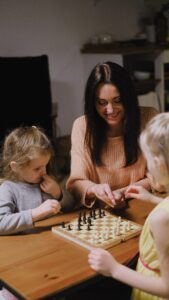
- Learning by making and doing (hands-on play). Creation is playful by nature: build models, prototypes, stories, videos, or games. Use LEGO, art, coding, music, or physical movement. Experience and experimentation are part of the fun.
- Invite imagination and pretend. Even abstract subjects benefit from make-believe. Approach math as treasure hunting or strategy planning. Look at grammar as “sentence engineering.” Discuss science as detective work or survival scenarios. Make believe lowers fears and raises engagement.
- Utilize social play. Play thrives on interaction: team challenges, collaborative puzzles, or peer teaching. Have friendly competition or cooperative goals. Social learning increases engagement and emotional safety.
Remember that a state of play happens when learners feel:
- Safe (no shame, embarrassment, or unneeded pressure)
- Autonomous (some control)
As you implement some of these ideas and begin to erase the line between school and play, your children will thrive emotionally and academically.