FUN · EFFECTIVE · FAMILY STYLE LEARNING
Have you ever stopped to think about how big a part of our academic culture grade levels are? To be clear, I am not talking about grades, as in how well a child performed on a particular task, such as receiving an A, B or C on a class assignment. I am referring to grades in terms of how we categorize a child’s academic progress. Grade levels are such a standard part of our experience that we often use grades interchangeably with age. If someone asked, “how old are your children?” and the parent answered, “2nd and 5th grade,” nobody would think, “well, that did not answer my question!” Stating someone’s grade level usually gives us a pretty clear picture of how old a child is and where they fit in with the rest of the kids we know.
Grade levels have become firmly entrenched in our system for several very good reasons.
The first year I home schooled I made sure to have math, science, language arts, and social studies books on hand for 1st, 3rd, 5th, and 6th grades—the grades that corresponded to the children I was homeschooling. However, it did not take long to figure out that grade-level-based texts and curriculums were a no-go. They did not end up serving the need I thought they would. In fact, they seemed to actually get in the way.
 Case in point: my oldest daughter was a conscientious student and sailed right through her 5th-grade language arts curriculum. She was happy as a clam knowing she was doing “A” work, just like she always had. I was perfectly happy too, until I realized that she was not learning anything new. It was just busy work for her and a total waste of time and talent. That being said, it was still surprisingly hard to give up the security of that structured program and come up with something that was actually challenging her. We made the transition successfully, and it ultimately proved to be the right decision.
Another case in point: my son struggled with any textbook work, and math was particularly difficult for him to plow through. This put us in a bind as he got older. He had only done part of a second-grade math book. He still did not have the attention span to do much more than that, but was approaching the age where he was expected to be competent at multiplication, division, and similar concepts. What were we to do? If we stuck him in a 6th-grade math book (the one that matched his age or “grade” level), he would not have had the mathematical foundation he needed to complete his work. If we put him in a second-grade book and made him plow through 3rd, 4th, and 5th grade to catch up, he would be hopelessly behind and would never catch up. The sheer volume of work required would have compounded many of the problems we were already having with him.
Both these problems are common: 1) A book moves too slowly or is way below a child’s abilities, or 2) the book moves too fast for the level of work a child can produce. I found that placing a child in a particular grade level of textbook was like locking them onto a treadmill set at an arbitrary speed for the typical student. Depending on the subject and which child I was working with, it was often too fast or too slow to best meet that child’s needs. Grade levels are a necessary evil in traditional classrooms, so teachers can effectively manage large classes, but they can be very counter-productive in a homeschool setting.
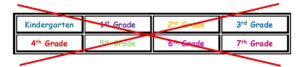
I found that the easiest way to manage homeschooling was to give up the idea of having grade levels. There was no 1st grade, 2nd grade, etc. I started to look holistically at what my child needed to know. What skills did my child need to thrive in life? What collection of information constitutes a well-rounded science background? What math concepts and skills are required to jump into Algebra? What does a child need to do to become a competent writer? With this new mindset, it did not matter if the child studied photosynthesis in 4th or 8th grade, but it did matter that they eventually understood the concept. It did not matter if they could write a beautiful essay in 4th or 8th grade, but it certainly mattered that they were eventually able to write well. School is a continuum of learning that is as flexible as you allow it to be.
Our goal at Simply Smart Learning is to help you:
A subject-based rather than grade-level-based curriculum has been a windfall for our family. It takes away the stress of having to make sure each child finishes a textbook each year for each subject and instead, allows the freedom to progress through the various subjects at a speed and in a sequence that works for each specific child.