FUN · EFFECTIVE · FAMILY STYLE LEARNING
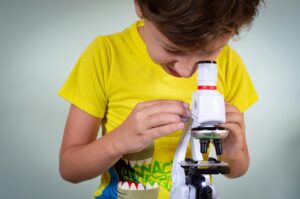
Babies love to explore! This obsession with exploration is hard-wired into young children, so it is tragic when children go to school—at the height of their curiosity—and are told, “Let’s study science! Here is a textbook. Let’s go through it.” Children want to see, touch, feel, experiment, and explore, rather than having information spoon-fed to them.
The key to successfully teaching science has little to do with covering the standard science topics presented in each traditional grade level and everything to do with fostering an insatiable interest in exploring the world. This happens when children can experience science in meaningful and engaging ways.
Simply Smart’s Experiencing Science curriculum was created to help parents accomplish this. In contrast to traditional science programs, Experiencing Science is, by nature, very eclectic. Students can utilize a wide variety of activities, experiments, field trips, research projects, books, ready-to-use science kits, videos, and cooperative learning classes. There is considerable latitude in terms of what concepts are studied and when. What really matters is that learning is fun, relevant, and as hands-on as possible. Experiencing Science is well-suited for family-style learning and co-ops because it is easily adaptable to multiple age groups simultaneously.
So, how do you let go of the traditional grade-level science books and not worry about what your children might have missed? The secret is simply having a plan and a clear vision of the end goal. Simply Smart’s Passport to Science book helps with this. It makes it easy to track each student’s progress. Students get a sticker in their science passport book as they study different topics. It does not matter if they study it by watching movies, reading books, attending science classes, doing experiments, or going on field trips. When a child studies or reviews a topic, they record it in their passport book and continue their explorations. The magic of using the passport approach is that children can see their progress. They can also see what topics they have not explored, which creates a natural curiosity to read and study more.
The following keys can help open your child’s eyes to the wonderful world of science:
Key #1: Utilize a Wide Variety of Resources. You don’t need to rely on a single science curriculum. Draw on the best of everything—books, videos, activities, research, available classes, subscription crates, field trips, etc.
Key #2: Track Progress with a Master Outline: When learning comes at random times and from various sources, as science often does, students will be much more efficient and effective if they keep a master outline tracking what they have learned. Simply Smart’s Passport to Science book makes this easy.
Key #3: Focus on Hands-On Learning: Children learn best by seeing and doing. The more involved and interested they are, the more likely they are to understand and remember what they have learned. Use as many hands-on activities and experiments as possible. Teaching science in a co-op setting greatly facilitates this approach.
Key #4: Develop a Scientific Mind: Science is more than memorizing facts. Students should learn to think like a scientist. Help children practice observing, comparing, asking questions, developing hypotheses, and finding answers to their questions. Encourage students to write regularly on scientific topics and to present their research to others.
Key #5: Create a Student Science Notebook: Have students keep a science notebook summarizing what they have learned. Keeping a well-organized science notebook can be an invaluable reference for children as they get older. It also helps them retain information and develop strong organizational skills.
Simply Smart’s Experiencing Science program provides resources to support each of these keys. Utilizing these keys will unlock a world of learning for your child as you share the wonders of science and create lasting memories.