FUN · EFFECTIVE · FAMILY STYLE LEARNING

This is a long, but true story.
 Soon after we had our third baby, something unexpected happened that led to some of the most traumatic times we ever experienced as a family. It was 1981 and we had recently moved to California. While we were on vacation, still recovering from the move and having a baby, we found our four-week-old baby unresponsive. We rushed him to the nearest hospital, but it took 15-20 minutes to get there. We tried to give him mouth-to-mouth, but it turned out his heart was not even pumping, so it had no real effect. Once at the hospital, a team of doctors, nurses, and a defibrillator went to work. Finally, a nurse came out in tears and told us, “we have just seen a miracle in here.” They had resuscitated him. He was alive, but just barely. It had been 45 minutes between when we had found him and when they were able to restart his heart—way too long without oxygen for a happy outcome.
 He was life-flighted to a children’s hospital 5 hours away. We followed in our car the next day to find him in intensive care, still unconscious and on life support. Technology was not what it is now, and the doctors had no way to determine the cause of his heart problem or the severity of the damage, but they told us the prognosis was not good. After three days of agonizing anticipation, we went into the ICU to visit him. He opened his eyes and we knew we had our boy back—at least for the time being. They could not get his heart into a normal sinus rhythm, and he was still on a breathing machine, feeding tube, and wired up to every machine under the sun.
He spent two weeks in intensive care. The doctors consulted with every specialist available and even discussed sending him to Houston where more tests could be run. Again, pediatric cardiology was far less advanced back then, and they did not feel it was worth the risk. He lay in his crib, his hands wrapped and pinned to the mattress so he would not accidentally pull out a tube. You could tell he was crying, but because of the ventilator, you could not hear any sound come out. We could not pick him up to comfort him. It was heartbreaking to watch.
At the end of those two weeks, the doctors told us there was nothing more they could do for him and that we should take him home and enjoy being with him as long as we could. We asked what the diagnosis finally was. The head of cardiology looked straight at us and said it was a syndrome unique to our child. He indicated, “we have never seen this before and we hope never to see it again.” We returned to California, and at the doctor’s recommendation, we checked our son into a California hospital for an overnight stay so they could establish a chart for him. Convinced that they could get to the bottom of the problem that the other doctors could not, they decided to keep him in the hospital. Those were the blackest weeks of our lives. We were torn between trying to care for two toddlers at home and spending as much time as we could with our son. Things dragged on and on with no answers. Finally, after three more weeks in the hospital, they came to the same conclusion—they had no idea of the cause, no idea of why he was still alive given his erratic heart arrhythmias, and no idea what the prognosis was for the future.
 We took him home and did our best to get back to normal life. They could not send him home with a heart monitor since our son’s heart was so erratic, the monitor would just constantly go off. We purchased a stethoscope, which we used to see if his heart was regular enough to put him down in his crib each night. We developed a routine where we would take turns in the morning. One day, I would go in to see if he was still alive, and the next day, his dad would go in. Occasionally, when his heart was so bad that we could only count 25 or 30 erratic beats a minute, we would drive the half hour into the emergency room, where they would confirm the irregularities and send us home hours later with no answers. By the time he was two years old, trips to the emergency room became way less frequent, and his heart became much more regular.
 During those early years, my son definitely did not fit into the same mold as our other children. He was slower in his development and had very poor emotional regulation. He did not talk until he was almost four years old, making communication challenging. His ability to deal with frustration was low. There were times when he was truly a sweet and tender little child, but there were also moments when we did not know how to deal with him. Although his communication was behind, he appeared to be a very bright child. We came to the conclusion that many of his behavioral problems were related to the trauma he experienced as a baby. Furthermore, we realized that those two years of never knowing if he would be alive the next day or not caused us to subconsciously detach. He got our care, but the normal parent/child connection was lacking. He was increasingly withdrawn and uncooperative. He did not trust anything in life—even us.
 Having realized the problem, we made a concentrated effort to break through and establish a healthy connection with him. We gave him as much love and physical affection as we could. When we could see him withdrawing, we would get down on the floor right in front of him and look directly into his eyes. It was months before he could even stand to maintain eye contact. For the next two years, we concentrated most of our efforts on establishing a relationship with him. We finally got him to the point where he would communicate when he was upset instead of throwing a tantrum. He became a very loving, affectionate child. Although he was still a little slow in his development compared with our other children, he started to fall within a normal range. He still had a tough time sitting or behaving in a classroom situation, but by the time he was turning four, we felt good about the progress he was making.
Then he turned five, and we enrolled him in kindergarten. Things went radically downhill from that time on. He had a wonderful, sweet teacher who tried everything she could to get him to sit and do his work. Still, his disruptions to the class were so bad that he spent much of the year sitting in the principal’s office. In first grade, things only got worse. He would not do any work. He would not listen or obey. He disrupted the class by doing things like standing up on his chair and yelling at the top of his lungs while the teacher was trying to talk. He hit other children. School life rapidly became a nightmare.
The teachers knew that he had severe learning disabilities, and one told me that they thought he was somewhat retarded. I had a hard time believing that given all the things he did that were mentally advanced for his age. After meeting with the teachers and staff, we decided to have him tested for special education placement. It came as quite a shock to the teachers to find that my son had an I.Q. of 130. Since the tests indicated that he should have been achieving much more at school than he actually was, he was placed in a resource teaching program.
During this time, the pediatrician tried medication for hyperactivity, which his cardiologist immediately discontinued because it counteracted his heart medicine. We took our son to a good psychiatrist who, as a last resort, suggested we try an antidepressant. That did not work either. The psychiatrist indicated that the prognosis for children like our son was not good, especially as he got older, and we could see he was right. We began to feel like we were locked into a hopeless, no-win situation.
By this time, our son had spent more hours in a special resource classroom than in his regular class. My husband would go to school during his lunch hour to help our son with his work. His older sister came from fourth grade every day to sit with him and help him stay on task. Still, his work was not getting done. By the time he finished second grade, he had only made it through 30 pages of a first-grade math workbook. I gave up trying to make my son spend all his time after school finishing schoolwork; it only made matters worse. He was an angry, aggressive, unmanageable child. I was a frustrated, scared, despairing mother.
My son’s teacher would send him home with a daily report card stating things like, “I stayed in my seat. I finished my work. I did not talk out of turn.” If he got all five items marked off, he would come home with a “good day” sticker. The reward was that the whole family got to go out to a restaurant of his choice. He only got one “good day” sticker the entire year.
 The final straw came at the end of that school year when our family attended the school awards ceremony. My daughter got the top student award in three subjects for fourth grade. Our older son got the top math award for fifth grade. At the end of the ceremony, our younger son had disappeared. I finally found him all by himself, huddled on the side stairs by the stage. He was crying. I asked him what the problem was. Between sobs he said, referring to his older siblings, “They do not even try, and they get the top student awards. I tried as hard as I could and I only got one good day sticker the entire year.” The pain he was going through hit me like a ton of bricks. What must it be like to feel like you were a failure with no hope of success? What must it be like to feel no matter the effort you put in you could never meet expectations? How frustrating must it be when you were compared to other children who did not struggle with the things you did?
That was the week we decided to drop out of public school and bring our son home. It was clear from his experience at school that he had learning disabilities, particularly when it came to reading and writing. His greatest handicap appeared to be his inability to sit still and focus on a task long enough to accomplish anything. I was at a loss as to what to do with him. One day I was agonizing over how to deal with the frustration I felt every time I tried to sit down and work with him on any kind of schoolwork. The thought came to my mind, “do you remember how much happier he was back when he was four? He needs to go back to that point in his life and start over!” That sounded easy enough until I stopped to think about it. He was now in third grade. Third graders do a lot of work. They read well. They can write nice reports. What would people think if I didn’t make my son do all those things? Then another answer came: “You cannot make your son do anything, but you can help him start wanting to learn.”
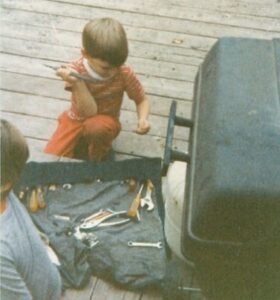
I was a school teacher by trade and racked my brain to remember anything that might cast some light on how to proceed. Slowly, pieces started to fit together, and real progress, as invisible as it might have been to the outside world, began. I decided to let my son “start over” and essentially go back to being four. I found “unschooling” was the answer for him. We kept screens off and filled the house with fun, enticing things to keep a little boy busy. To this day, when someone asks what my son did for school during those early years, everyone in the family replies, “he spent his time out in the back yard digging holes.” That is not too far from the truth. School looked like Legos and craft projects, bike riding and building forts.
 You may ask, was I comfortable with that? The answer is no, not at the time, but I could not find any other alternatives. It was pretty scary when my son entered 5th grade (age-wise, there were no grade levels by this point in our homeschooling), and he still did not know what multiplication was. The peer pressure would have been too great for me had it not been for the fact that our close friends knew what we were dealing with and those outside our family could see the progress the older kids were making, so they gave us the benefit of the doubt.
My son began his first math book at age of 12, jumping straight into Saxon. I do not recommend this, but I have to be honest and tell it like it really was. He was fourteen when he wrote his first short paper. His total reading experience consisted of science encyclopedias and family scripture time. By the time he was sixteen, he decided doing Saxon Math on his own was not working for him, so he enrolled at the junior college to take Algebra II/Trig. By the time he finally left home to go to college at eighteen, he was ready to enroll in Calculus and Physics. He graduated with a BS in computer science in four years and has since worked as a computer engineer.
So what about all those disabilities he had? They seemed to fall away one at a time. I have even wondered if they ever existed, or if what I really saw falling away was my preconceived notions of how a child ought to think, act, and feel. I am amazed that he could have even been labeled as having disabilities in the first place, especially after I read what the dictionary said disabled meant: “Deprived of ability or power; crippled.” So far, I have not found anything my son has been deprived of the ability or power to do. Given space, time, and security to grow at his own pace, he has been able to accomplish almost everything.
 So what about crippled? I must say that my son used to be crippled, but it was his spirit that was crippled, not his mind or his body. Trying to make a child fit into somebody else’s preconceived mold will cripple them. It does not take long before a child realizes they cannot pretend to be the person they are being arbitrarily forced to become, and they give up trying. As time passed, my son became happier and more confident. He forgot he was ever considered a failure. He learned more about himself, what he could do, and how to problem-solve through things that were hard for him.
I learned through our experience that every child is a gifted child. Every human being has a unique set of abilities and strengths. Along with that, they have things that do not come as easily, but that does not constitute a disability that has to cripple them. It merely means there is room for growth. Love, faith, patience, persistence, and a liberal sprinkling of inspiration, can overcome all of that.