FUN · EFFECTIVE · FAMILY STYLE LEARNING

I have six children. One would think there would be more commonalities than differences between them. I am not sure that is the case. They don’t look alike. They don’t think alike. They don’t respond to the world in the same way. Their personalities and interests are very different. So, it stands to reason that the way they learn, as well as their propensity for doing schoolwork, would be different. When I started homeschooling, it didn’t take long—maybe a day or two—for those differences to become crystal clear.
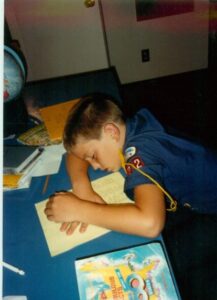
While our second child—a daughter—was an overachiever who thrived on schoolwork and just about any other task she was given, our oldest son had a very different personality. He was also very bright and in the gifted program. In fact, his 5th-grade teacher said he was the brightest student he ever had. That said, he certainly was not an overachiever. He was famous for doing just enough to get by. Things did not change much when we started homeschooling. I would have died of shock during those first few years to see him doing schoolwork without being pretty much forced to do it.
This resulted in considerable conflict between mother and son. Our first year of homeschooling, there was at least one day a week when I would threaten, “Get your clothes on. I am going to put you back in school. You can’t just sit around all day!” Granted, he was not just sitting around. He was reading like a vacuum cleaner. The rest of the time, he was obsessed with building things. He got his HAM radio license. He built remote-controlled airplanes. He always had a project. The problem was what his school looked like did not match my idea of what school was supposed to look like. It took me a while to get used to it, but we were eventually able to come to an understanding and make things work.
Initially, getting him to do anything out of a math book was like pulling teeth. However, that started to change when he decided he wanted to design and build a hovercraft. To build it, he had to cut a circle out of a 4 x 8 sheet of plywood. He needed to know the area of that circle in order to determine which motor would provide the correct amount of lift. Calculating the area of a rectangle was easy, but he had not learned how to calculate the area of a circle yet. He asked me for help. I responded, “Funny you should ask!” and showed him that in just a few lessons, he would learn the formula for calculating the area of a circle. We discussed how math has practical value and was worth his time to pursue.
I need to be perfectly clear—he never liked the tedium of doing hours of math—not in high school or in college. However, once he realized it was a tool he needed to reach his goal of being an electrical engineer, he was able to plow through it very successfully. That is the way he approached most of his high school work. He was not necessarily cheerful about it, but he did plow through it simply because it was a necessary means to an end. That ended up being okay with me and got him where he needed to go.
Our high school curriculum was fairly rigorous, but he spent the majority of his time on other stuff. He spent a lot of time reading Tom Clancy and science encyclopedias… not the classic literature background our daughters received, but it worked. We started to see the results of letting him take accountability for the learning process. It was a delightful change to see him tackle a project and put his heart into it just because it was important to him or because it needed to be done. Few things in this life come free, and education is no exception. He came to terms with the fact that if he wanted a particular result, he had to put in the work. That lesson alone was far more valuable than the academic material he studied along the way.
To put it simply, there is no single way to educate a child. What works for one may not work for another. Home-centered education allows you the flexibility to tailor each child’s education to their unique needs, abilities, and personalities. Enjoy your child. Get to know them, understand how they think and then develop an educational process that works for them.