FUN · EFFECTIVE · FAMILY STYLE LEARNING

There is a famous and often quoted exchange between Alice and the Cheshire Cat in Alice’s Adventures in Wonderland that goes like this:
Alice: “Would you tell me, please, which way I ought to go from here?”
Cheshire Cat: “That depends a good deal on where you want to get to.”
Alice: “I don’t much care where—”
Cheshire Cat: “Then it doesn’t matter which way you go.
As we start charting our educational course, it is important to think about where you are headed—or more importantly, what your real educational goals are. To paraphrase, it doesn’t matter what you do in school if you don’t care where you’re headed in life. Rather than focusing on the here and now of what your 4th grader needs to know, think about what you want your child to become and take with them when they leave your home. We all want our children to be well-educated. That includes the basics—reading, writing, math, science, and social studies (read more about specific goals here). However, education extends far beyond studying various academic subjects. A quality education develops the whole child. What does that look like? Here are a few ideas to consider.
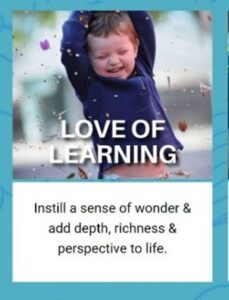
Love of Learning

Too often we try to force-feed information to children, rather like a baby learning to eat. Having to spoon-feed information when a child is neither interested nor motivated is tedious and ineffective. Maybe you will succeed in getting your child to learn their ABC’s, but what good is being able to read if the child hates doing it and fights you whenever they have to open a book? By contrast, if a child loves reading, even if they learned to read a little later, they will soon surpass those who hate reading, but learned earlier.
Children who love learning are constantly exploring the world around them and broadening their perspectives. Their sense of wonder and curiosity prompts them to ask questions and seek answers. Not only are they easy to teach, but they become self-teaching, life-long learners. School is no longer something they do each day because they must, but rather it is a way of life.
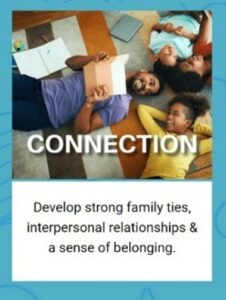
Connection
Human beings have an innate need for connection and a sense of belonging. A quality education equips students with interpersonal skills and the tools to communicate and share with others. It provides insight and perspective into others’ cultures and experiences. It helps children to develop meaningful relationships and strengthen bonds with parents, family members and friends of all ages.
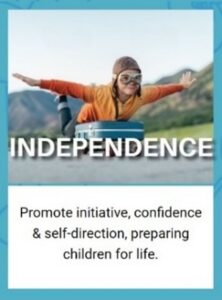
 Independence
Using an oft-repeated analogy, you can focus on giving your children fish or teach them how to fish for themselves. A quality education builds confidence and promotes initiative. Rather than always being told what to do, as is often the case in a traditional classroom, children who grow up in a rich, safe, home-centered learning environment quickly transition toward more self-directed learning. They learn to pursue their interests, to be problem-solvers, and to take accountability for their academic success. Independence and confidence are essential stepping stones in preparing children for life.
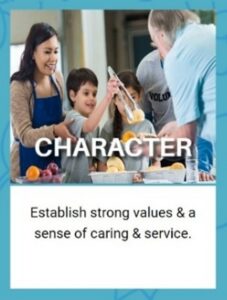
Character
Perhaps the hallmark of a truly great education is not what a child knows, but what they become. Their character is shaped in a way that helps them develop time-honored values such as integrity, compassion, respect, responsibility, perseverance, and courage. Their spiritual development leads them to a life of faith and service. They develop leadership skills and are prepared to step into adulthood as a contributing, well-grounded member of society.
Excellence
True education promotes excellence rather than mediocrity. Students work to master curriculum subjects to the greatest degree they are able. They can evaluate information, think critically, articulate ideas and build on what they have learned in meaningful ways.
A quality education is not just about the facts we learn, but about everything we internalize along the way. How we teach, what kind of experiences we provide, and the child’s opportunities to develop are all important parts of that education. Simply Smart provides ideas, not just about curriculum, but how to structure learning activities in a way that encourages the development of these characteristics (read more here). Our curriculum is focused not just on learning facts, but developing the whole child. When a child is making progress towards developing a love of learning, connection, independence, character, as well as a desire for excellence, you know you are headed in the right direction.